
Meet the candidates: Waterbury Select Board 1-year contenders
February 26, 2026 | By Sarah Andrews | Correspondent
Each year, the Waterbury Select Board’s two one-year positions are on the Town Meeting Day ballot.
This year, neither of the incumbents are seeking re-election, opening a race to completely new members. Three candidates have stepped up for voters to consider: Evan Karl Hoffman and Sandy Sabin, who both ran last year in a four-way race for the two spots and fell short, and Martha Staskus, running for elected office for the first time.
Along with the candidates for the three-year board seat on the ballot, they shared their views in a Waterbury Roundabout survey on a host of local issues that the Select Board will likely deal with this year. They also each talked with Waterbury Roundabout about running for local office.
Below are highlights from interviews with Hoffman, Sabin and Staskus.
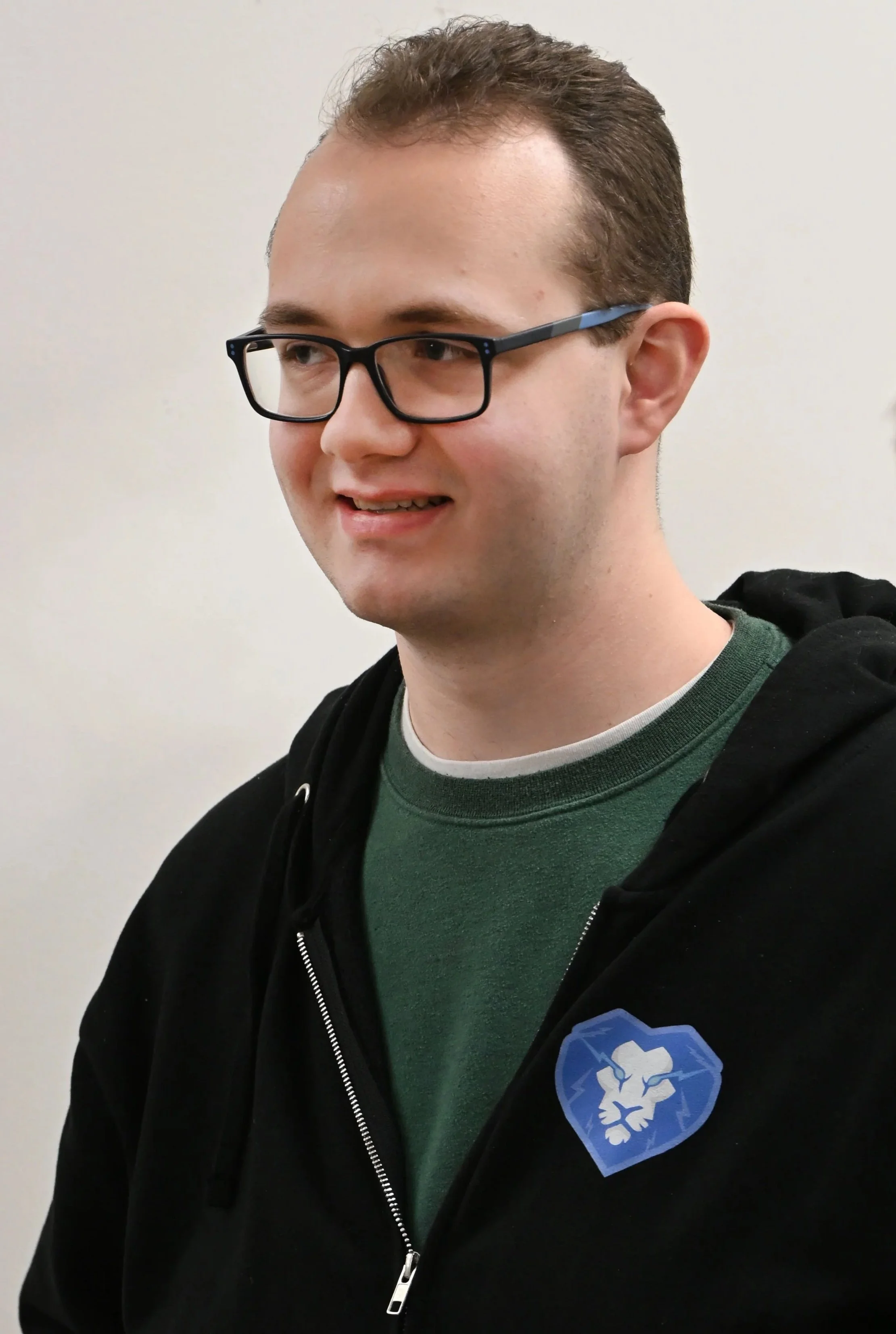
Evan Karl Hoffman is among a handful of regular attendees at select board meetings. Photo by Gordon Miller
Evan Karl Hoffman
Last year, Evan Karl Hoffman ran for the same position for which he’s on the ballot this Town Meeting Day. The 29-year old, who has been regularly attending select board meetings for several years, said he first turned his eye toward local government after the town charter creation in 2023. Learning about that process, Hoffman said he was hooked, and he decided he would run for the select board to help support his community.
“I felt like it was time for me to give back a little bit,” Hoffman said. “I can bring some fresh ideas and a different perspective, as a young person, especially. It feels like just about everybody I went to high school with has moved away to a different state.”
The 2014 Harwood Union High School graduate works in the deli at the Village Market. He said he worries about the sustainability of jobs like his own, as living in Waterbury becomes increasingly harder to afford.
“I have this vision of the future where everyone who works in a job like that has left, and there’s no one left to work in the grocery store, at a school, or at bars and restaurants,” Hoffman said.
Rising costs for housing are part of his concern. That, paired with the town’s debt, impacts Hoffman’s vision of the future.
“I see issuing debt as imposing taxes on the next generation. Issuing that debt now means people will be paying more for it later,” Hoffman said. “Using that local options tax to pay that debt up front is a great idea.”
The top issue for Hoffman? “Number one has got to be housing and affordability,” he said.
He explained that he supports the town’s new program to encourage homeowners to create Accessory Dwelling Units – where they add on to an existing home or renovate existing space to create a new apartment – but he recognizes that it isn't a complete solution.
“I certainly think it's a piece of the puzzle,” Hoffman said. “This is a lot more affordable in terms of bang for our buck.”
Hoffman supports the town entering a proposed exclusivity contract with a developer to design housing on the Stanley-Wasson site at the State Office Complex. The proposal from DEW Construction to build approximately 90 apartments in close proximity to the Winooski River and the nearby Randall Street neighborhood, that’s been hit numerous times by floods, has many community members worried. They fear a large new structure in that location will make future flooding impacts worse.
“We should give the developer that time,” Hoffman said. “Since the developer is taking on basically all of the risk at this point, I don't see any reason why we shouldn't move forward with it.”
He recognizes his neighbors' concerns about development in a floodplain, but said it is too early in the process to know for sure. “I feel like it should be possible to not make flooding worse, and not only that, but potentially mitigate it for our neighbors,” Hoffman said.
To the point of flood mitigation, Hoffman also is a strong advocate for the Randall Meadow project that’s on the March 3 ballot with a question asking voters to authorize bonding to help secure a $2 million federal grant towards an estimated $4.3 million project.
“I'm very glad that we have a lot of grant money already lined up. That is a really important project that needs to move forward,” Hoffman said.
Looking beyond flood and housing concerns, Hoffman said he is optimistic about increasing town participation in local government. To that end, he’s joined new committees to study ways to improve involvement in town meeting and to plan celebrations to mark the U.S. and Vermont 250th anniversaries this year and next.
He said he also would like to focus on communications and outreach. “I'd like to try to get more people going to meetings and expressing their opinions. I think it will help the town do its job better,” Hoffman said. “I'm just really looking forward to the opportunity to serve and to get to meet more of my neighbors.”
Sandy Sabin
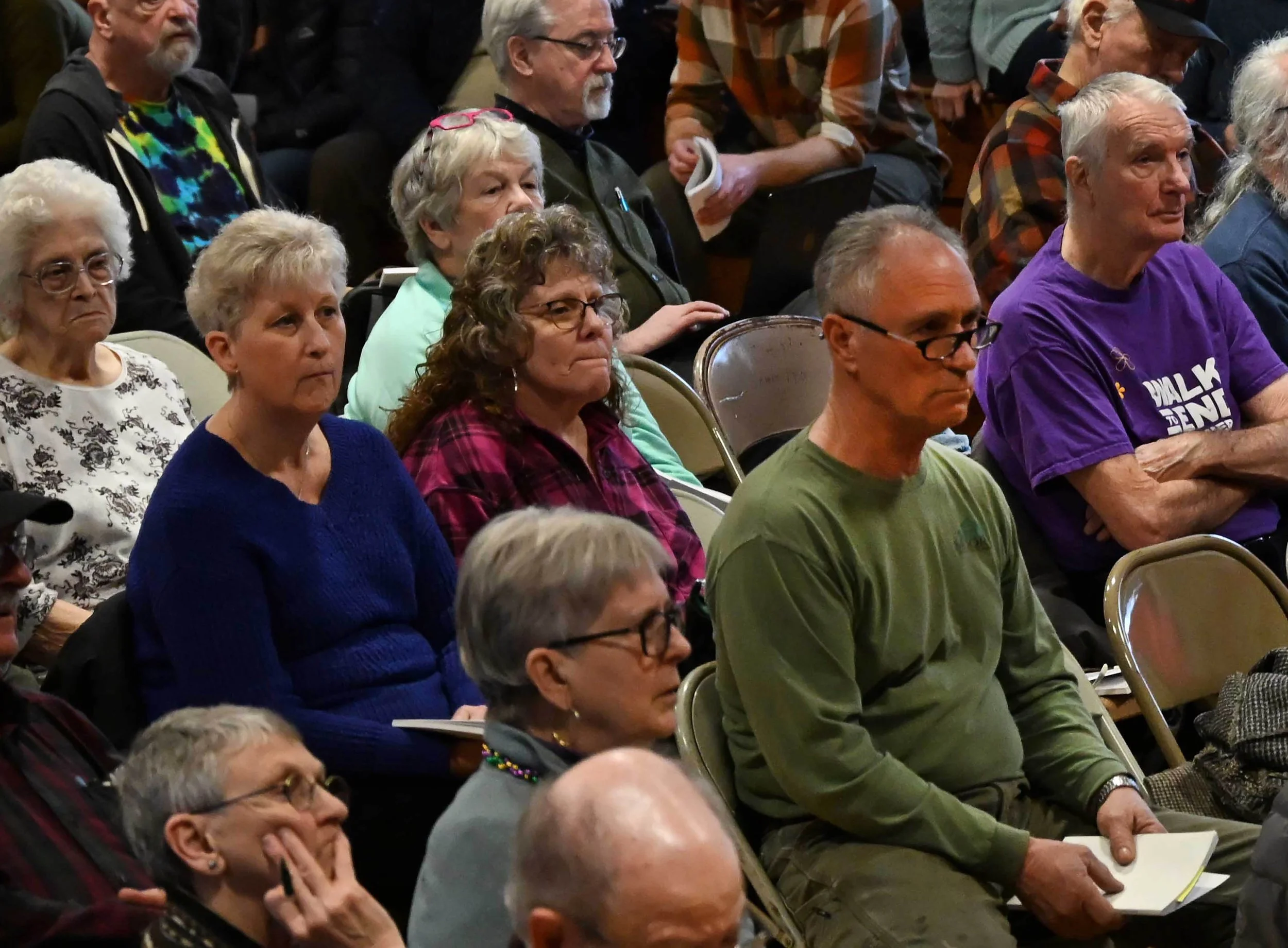
Sandy Sabin (left in blue) listens at town meeting in 2025. Photo by Gordon Miller
Sandy Sabin ran as a write-in candidate in last year’s select board race. Friends and neighbors know that Sabin frequently attends select board meetings and is on the town’s Housing Task Force.
“I’ve been going to select board meetings for a few years, and it's my community,” Sabin said. “I grew up here, and I want what's best for Waterbury.”
For Sabin, housing and affordability also are the most pressing issues facing the town. Sandy owns a home in Waterbury and recently added an Accessory Dwelling Unit to her basement, as part of a state-subsidized initiative.
“I've grown up here, and I hope that I can afford to stay here,” Sabin said.
Sabin said she considers herself a champion of the people as she participates in sometimes contentious discussions at select board meetings. She hopes that if she is elected, she can be a listening ear for the community’s desires and needs, but in a position to take action.
“We need to build a community that will be something that younger people will come to, to keep our community going,” she said.
When Tropical Storm Irene hit Vermont in August 2011, Sabin recalls that she was working at the state offices in downtown Waterbury. Like many in town, she has seen firsthand the way flooding can impact homeowners.
Asked about the potential to build affordable housing on the former Stanley-Wasson site, Sabin is hesitant but supportive. “A lot more needs to be done, and we shouldn't be jumping into it until we know more,” Sabin said. Like many others, she says she’s concerned about the potential hazards of building housing in the flood zone.
To address affordability, Sabin points to local option taxes as a valuable revenue source, and she wants to see that revenue used to support the town’s long-term interests. In 2026, for example, town officials expect the new taxes on rooms, meals, sales and alcohol will bring in at least $900,000.
“The local options tax brings a lot of revenue, but there are so many current infrastructure problems that we have,” Sabin said. “I feel like there should be more put toward current issues that we have, rather than starting new projects.”
During this transitional period for the town, Sabin says she prioritizes being thorough and transparent. Her background in municipal finance through her job with the town of Stowe gives her technical knowledge when it comes to budgeting and contracts.
Most importantly, Sabin says she is dedicated to seeing her community thrive.
“I grew up in this community, and I really care about Waterbury,” Sabin said. “I hope that if I am voted in, my love of Waterbury shows through.”
Martha Staskus
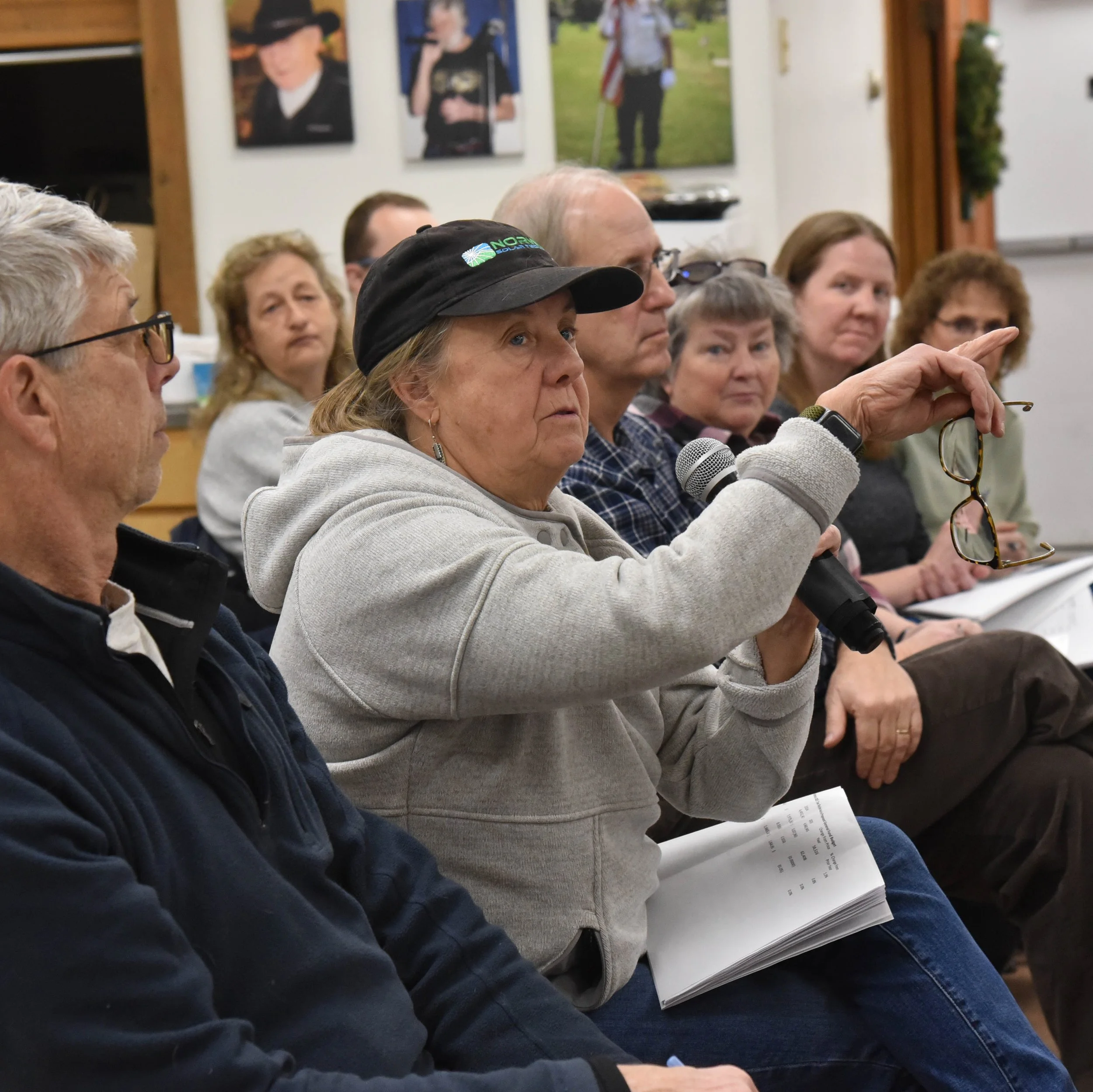
Martha Staskus comments during Waterbury's Have Your Say Day budget meeting in January 2025. Photo by Gordon Miller
Martha Staskus has never held elected office in town, but has almost two decades serving the town having been a member of the Zoning Board, the Development Review Board, and now as chair of the town Planning Commission.
Staskus and her family have lived in town for almost 30 years. Her kids participated in town programs and went through the Waterbury schools.
Staskus works in renewable energy development at Norwich Technologies, based in White River Junction. She said she hopes her experience in business management, budgeting, and contract review will help the board with logistics and finances. “I think it’s important that I can share my history and experience,” she said.
Following the recent exodus of town employees, Staskus said she hopes for a return to stability. “Right now is a very transitional time for Waterbury, you know, we have significant losses in staffing,” she said. “I hope that by bringing on a new [select] board, we’ll have some fresh eyes, some knowledgeable eyes. We can right the ship and get us moving in a forward direction.”
Staskus says it’s her development experience that influences her thoughts on the potential Stanley-Wasson housing development. She said there are many factors and regulations at play, but she ultimately supports the town agreeing to an exclusivity contract with a developer.
“I think it's appropriate to go through this predevelopment phase before we jump to any conclusions about whether something is viable there or not,” Staskus said.
Asked about what she considers other key issues facing the town, Staskus said affordability and flood mitigation are at the forefront. “I think those are critically important. When folks talk about affordability, or flooding, you have to talk about people, too,” Staskus said.
Also related to housing, Staskus said she supports the push for more ADUs, but has been disappointed by the tepid interest from the community so far. A new program introduced last fall to use town funds to help property owners create new units has only had two applications to date. “You can have these plans in place, but if they aren't being implemented, why aren't they being implemented?” Staskus asked. “Thats sort of the next step in my mind.”
Her opinion on flood mitigation is that Waterbury should follow initiatives being taken on a state level, but she said she supports the Randall Meadow proposal.
“The state is sending a positive signal by granting funding for the Randall Meadow project, as long as we keep our eyes open for what else we can do,” Stasksus said.
For the past several years, Staskus’s work on the Planning Commission has been largely focused on the recent update to part of the town’s zoning bylaw that covers the downtown swath of the community. The commission is now deep into its process to rewrite the town plan, which it is aiming to complete this year. After that, it will resume zoning bylaw updates for the rest of the town.
If elected, Staskus said the two roles would be too great, and she would step away from the Planning Commission. She said she’s confident that the current Planning Commission members can bring the town plan project to completion.
Moving on to serve next on the select board is an opportunity to support the town in new ways and to bring her years of professional and planning experience to the board.
“I think it’s important, as residents, that we participate however we can,” Staskus said. “I feel good about helping the town, participating in town activities, and helping to plan for our future.”